/

/

Search
Category
2026-08-21
Industry News
Automation equipment often depends on small components that perform simple movements again and again. A product may need to move forward, return to its original position, hold an item, or help another part reach a specific location. These actions may look simple from the outside, but reliable movement is important to the overall workflow.
A Double Shaft Air Cylinder is one component used for this type of task.
Unlike a conventional cylinder with one moving shaft, a air cylinder uses a paired shaft arrangement to support movement. This design can provide a more guided motion and may help equipment designers create compact mechanisms for repetitive work.
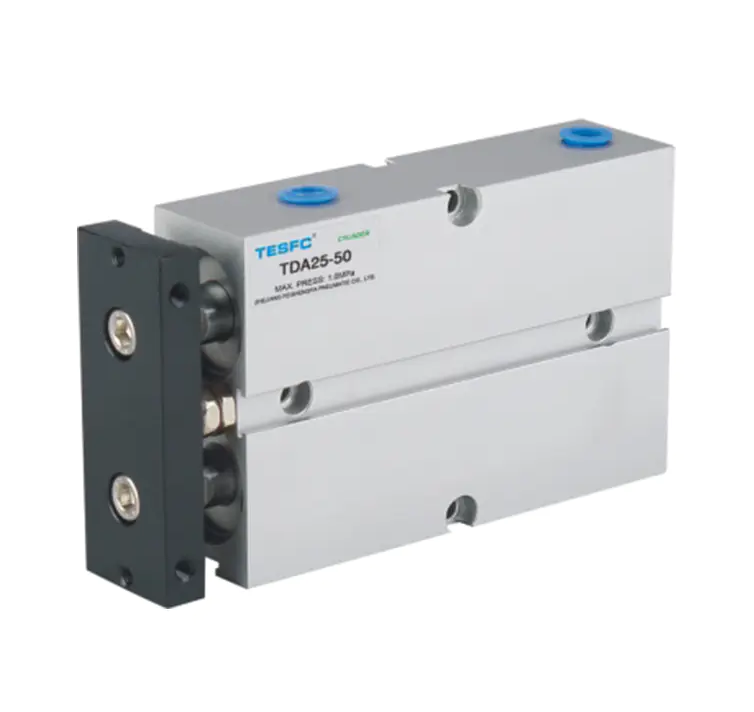
Its applications can be found across packaging equipment, assembly machinery, material handling systems, positioning devices, and other forms of industrial automation.
The actual application depends on the equipment design. A cylinder should match the movement, load, installation space, and working conditions of the machine.
An Air Cylinder converts compressed air into linear movement.
In simple terms, air enters the cylinder and causes the internal moving part to travel. The connected shafts then move with it. This movement can be used to push, pull, position, press, or guide another component.
The paired shaft structure is an important part of its design.
It can help support the moving part and provide a more controlled path during operation. This can be useful when the cylinder is connected to a component that needs to move along a defined direction.
Typical tasks include:
The cylinder itself does not perform the entire machine operation. It provides movement within a larger mechanical system.
This makes it particularly useful when a machine needs repeated linear action without requiring an operator to move each part manually.
The shaft arrangement is what gives this type of cylinder its distinctive role.
A standard air cylinder can provide linear movement, but some machine layouts need additional support for the moving part. A double shaft arrangement can help create a more guided movement path.
This can be useful when the cylinder is connected directly to a small plate, holder, pushing element, or other moving component.
Consider a simple packaging mechanism. A product may need to be pushed from one location to another. The cylinder can provide the movement while the connected part follows a defined path.
The paired shaft design can also help with the overall arrangement of the mechanism.
| Design Feature | Possible Role in Equipment |
|---|---|
| Double Shaft Structure | Supports guided linear movement |
| Compact Body | Helps fit movement functions into limited spaces |
| Linear Motion | Supports pushing, pulling, and positioning |
| Repetitive Operation | Suitable for repeated machine movements |
| Mounting Flexibility | Allows integration into different equipment layouts |
| Moving Platform Support | Helps connect the cylinder with external components |
The exact benefit depends on how the cylinder is integrated into the machine.
A well-designed system considers the cylinder and the moving component as part of the same mechanism.
Air cylinders can appear in many automated processes.
Packaging machinery is one example. A machine may need to move containers, guide packaging materials, position products, or support a repeated pushing action.
Assembly equipment is another area.
During assembly, components may need to move into a fixed position before another operation takes place. A cylinder can provide the repeated movement needed for this step.
Material handling equipment can also use these cylinders.
Products often move between different positions during manufacturing. A compact pneumatic movement system can help transfer or position items without requiring manual handling at every stage.
Other applications may include:
Positioning equipment
The cylinder can move a component into a defined working position.
Push mechanisms
It can move products or machine parts from one location to another.
Assembly systems
It can support repeated movements during component assembly.
Packaging machinery
It can help move products or packaging components through different stages.
Material handling
It can support simple transfer and movement tasks.
Inspection equipment
It can move an item into a suitable position for checking.
Small automated machines
It can provide linear movement where space is limited.
These applications share a common requirement: repeated linear movement.
Packaging machinery often contains many small movement tasks.
A package may need to be pushed forward. A container may need to be aligned. A product may need to be moved toward a filling, sealing, labeling, or sorting position.
These actions do not always require a complicated mechanism.
A Cylinder can provide a straightforward movement source for selected tasks.
For example, imagine a production line where individual packages arrive at a particular point. A pushing mechanism can move one package into another position before the next stage begins.
The cylinder provides the forward and return movement.
Another packaging system may need to hold a component temporarily while another operation takes place. The cylinder can support the positioning mechanism.
The advantage comes from the repeatable nature of pneumatic movement.
Once the machine is properly arranged, the same movement can occur as part of the automated workflow.
This can reduce the need for manual intervention in simple repetitive tasks.
Yes. Positioning is one of the practical uses of a Cylinder.
Many machines need components to move between known positions. The movement may involve a guide, stop, holder, or platform.
A double shaft arrangement can be useful because the moving element can be connected to a component that needs support while traveling along its path.
For example, an automated assembly station may need to move a part into position before another operation starts.
The cylinder can provide the linear movement.
The machine controls when the movement takes place. The connected mechanism determines what happens to the product or component.
This division of responsibilities is important.
The cylinder provides the motion. The machine system determines how that motion is used.
Positioning applications can include:
| Positioning Task | Example Application |
|---|---|
| Product Alignment | Moving a product into a working position |
| Component Placement | Bringing a component toward an assembly area |
| Stop Movement | Moving a stop into or out of a product path |
| Fixture Movement | Positioning a small holding fixture |
| Transfer Action | Moving an item between nearby positions |
| Inspection Positioning | Bringing a product into a checking area |
The suitability of the cylinder depends on the movement required by the equipment.
Factory equipment does not always have unlimited space.
Modern machines may combine many functions within a relatively small working area. Designers therefore need components that can provide useful movement without creating unnecessary complexity.
A Cylinder can be considered for compact mechanisms where guided linear movement is needed.
Its paired shaft design can support a moving platform or connected component while keeping the movement aligned with the intended direction.
This can simplify certain equipment layouts.
It does not mean that every compact machine should use a double shaft cylinder. The available space, mounting arrangement, movement requirements, and surrounding components all need to be considered.
The cylinder also needs enough room for its moving parts to operate safely.
Equipment designers may therefore review:
These factors can influence whether a Air Cylinder fits naturally into the machine.
Automation depends on repeatable actions.
A machine may perform the same movement many times during a normal production cycle. Manual movement would require constant operator attention.
Pneumatic cylinders provide a way to automate selected linear actions.
Air Cylinder can move forward and return as part of a controlled machine sequence. This makes it useful for operations that involve repeated pushing, positioning, or transferring.
The movement can be linked to other equipment functions.
For example:
Product arrives → cylinder moves → product is positioned → another machine action occurs → cylinder returns
This type of sequence can be repeated as part of an automated workflow.
The cylinder does not need to control the entire process. It only needs to perform the movement assigned to it.
This makes pneumatic components useful building blocks for larger automation systems.
Not every Double Shaft Air Cylinder is suitable for every machine.
The selection should begin with the actual task.
A manufacturer can ask several practical questions before choosing a component.
What movement is required?
Is the cylinder pushing, pulling, positioning, or guiding another part?
What is being moved?
The size and nature of the connected component can influence the choice.
How much space is available?
The cylinder needs to fit into the machine without interfering with surrounding parts.
How will it be mounted?
The mounting arrangement should suit the machine structure.
How often will it operate?
Repeated movement may place different demands on the component than occasional operation.
What is the working environment?
Dust, moisture, temperature, cleaning practices, and other environmental conditions may influence equipment selection.
How will maintenance be handled?
The cylinder should be accessible enough for routine inspection and care.
These questions can help manufacturers avoid choosing components based only on appearance or general size.
A production line is made up of connected processes.
One machine may feed products into another. A positioning device may prepare an item for inspection. A packaging machine may then handle the product before it moves to another stage.
Within this larger system, Air Cylinder can perform a small but useful movement.
Its role may be easy to overlook because it does not process the product itself.
Yet the movement it provides can help connect different steps.
A practical installation might use a cylinder to:
The cylinder works together with sensors, controls, mechanical parts, and other equipment.
This is why system planning matters.
The component should fit the overall workflow rather than being selected independently.
Routine care can help keep pneumatic equipment working as intended.
The exact maintenance process depends on the equipment design and operating environment. However, basic attention to cleanliness, connections, movement, and surrounding components can be useful.
Operators may check whether the cylinder moves smoothly and whether connected parts remain properly positioned.
The area around the cylinder should also be kept reasonably clean.
Loose material, dust, or other contamination can interfere with moving components in some environments.
Connections should be inspected as part of normal equipment care. Unusual movement, noise, or changes in operation may indicate that the system needs attention.
Maintenance is easier when the cylinder is installed in a location that allows operators to inspect it without dismantling unrelated equipment.
For this reason, accessibility should be considered during machine design.
The main difference is the shaft arrangement.
A conventional cylinder generally uses one main moving shaft. A Cylinder uses two shafts connected to the moving mechanism.
This difference can influence how the cylinder interacts with the attached component.
A standard cylinder may be suitable when straightforward linear movement is all that is needed.
A double shaft design may be considered when the moving component benefits from additional guidance or support.
The choice should therefore be based on the application rather than on the assumption that one design is suitable for every situation.
| Consideration | Standard Air Cylinder | Double Shaft Air Cylinder |
|---|---|---|
| Basic Movement | Linear movement | Linear movement |
| Shaft Arrangement | Single shaft | Paired shafts |
| Guided Support | Depends on the equipment | Can support guided movement through its design |
| Application | General movement tasks | Movement tasks needing additional support |
| Machine Layout | Depends on installation | Useful for selected compact mechanisms |
The actual suitability depends on the complete machine design.
A simple movement may not require the added features of a double shaft structure. A more guided mechanism may benefit from it.
Understanding the task makes the selection process clearer.
RECOMMENDED PRODUCTS

Phone: +86-15957736756
E-mail: [email protected]
Add: No.7, Yongxing Second Road, Chengdong Industrial Functional Zone, Chengdong Subdistrict, Yueqing City, Zhejiang Province, P.R.China
Copyright © Zhejiang Feishengya Pneumatic Components Co., Ltd. All Rights Reserved.
 Pneumatic Component Factory
 English
 русский
 عربى
عربى Español