/

/

Search
Category
2026-08-28
Industry News
Manufacturing equipment rarely works alone. A production line is usually a connected sequence of tasks. Materials enter the workplace, components are positioned, parts are joined, products are checked, and finished items move toward packaging or storage.
Adding a new machine to this environment is therefore more than placing equipment on an available floor area.
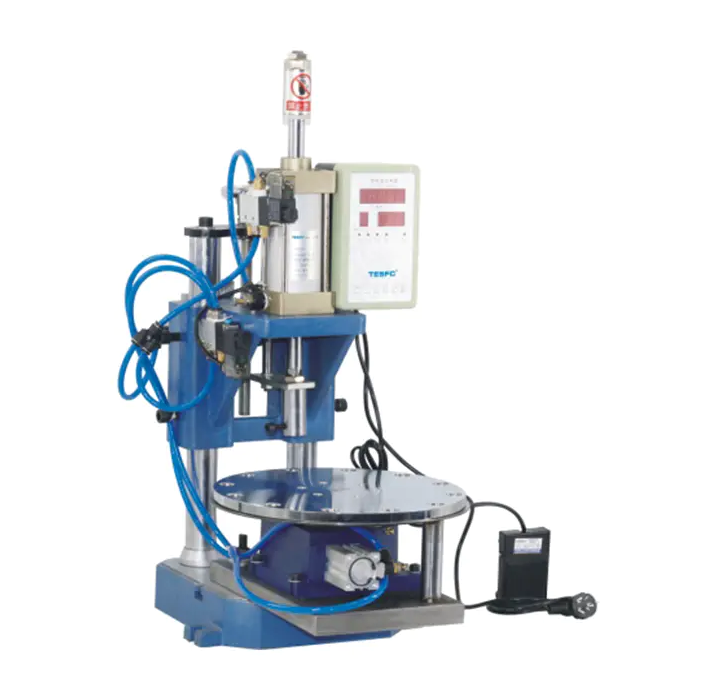
A China Pneumatic Press may perform pressing, forming, joining, or assembly tasks. Its practical value depends on how naturally it fits with the processes around it. If workers need to move products back and forth by hand, or if the new equipment interrupts an existing workflow, the expected benefits may be difficult to achieve.
A better approach is to look at the complete process before introducing the press.
The machine should have a clear role. Materials should arrive at the right place. Operators should understand how to interact with the equipment. The finished part should move smoothly to the next stage.
This approach can help manufacturers integrate a Pneumatic Press without treating it as a separate piece of equipment.
A pneumatic press can perform different tasks depending on the production environment.
It may be used to press one component into another. It can support assembly work, help form suitable materials, or assist with repeated joining operations.
In some workplaces, the press may become a dedicated station. In others, it may be integrated into a larger automated process.
| Production Task | Possible Role of a Pneumatic Press |
|---|---|
| Assembly | Helps bring components together |
| Pressing | Applies controlled movement to a suitable workpiece |
| Forming | Supports selected shaping operations |
| Joining | Helps connect compatible components |
| Positioning | Holds or moves parts during a production step |
| Packaging | Supports selected closing or forming tasks |
| Repetitive Work | Performs the same pressing action within a workflow |
The key is to define the task clearly.
A press should not be added simply because another machine is available. Its purpose should relate to an existing production need.
For example, if employees currently perform the same pressing action repeatedly, a pneumatic press may be considered as a dedicated workstation.
If the same action already happens automatically, the new press may need to communicate with other equipment or fit into an existing sequence.
The machine's role determines how it should be integrated.
Before installing a Pneumatic Press, manufacturers can examine how products currently move through the workplace.
This does not require a complicated study. A simple process map can reveal where the new equipment may fit.
Manufacturers can look at:
Material entry
Where do parts arrive?
Preparation
What needs to happen before pressing?
Pressing or assembly
Where should the new machine perform its task?
Inspection
Does the product need to be checked immediately afterward?
Next operation
Where does the finished part go?
Packaging or storage
How does the completed product leave the work area?
This approach helps identify unnecessary movement.
Imagine a production process where an operator collects a component from one location, carries it to another area, performs a pressing task, and then returns the finished part to the original production line.
The press may complete the pressing action efficiently, but the overall workflow still contains extra movement.
A better layout may place the press closer to the previous and following stages.
The goal is not simply to install equipment.
The goal is to improve the relationship between connected tasks.
Machine placement can influence how smoothly a production line operates.
A press needs enough working space for operators and materials. It also needs to be positioned where the incoming and outgoing workflow makes sense.
Manufacturers can consider several factors.
| Placement Consideration | Why It Matters |
|---|---|
| Material Access | Allows components to reach the press conveniently |
| Operator Position | Supports comfortable machine interaction |
| Product Flow | Helps products move naturally to the next stage |
| Maintenance Access | Leaves room for routine care |
| Safety Space | Helps separate moving equipment from surrounding activities |
| Nearby Equipment | Supports smoother connections between processes |
| Storage Area | Reduces unnecessary movement of finished parts |
The press does not always need to sit directly beside another machine.
Sometimes a small buffer area between processes is useful. In other cases, direct transfer may make more sense.
The correct arrangement depends on the production environment.
A common mistake is to focus only on the physical size of the press.
The surrounding space matters too.
Operators need room to load and remove parts. Maintenance personnel need access to the equipment. Materials need a clear route through the workstation.
Good placement considers all three.
Not every production line is fully automated.
Many workplaces combine manual operations with machinery. An operator may place a component into position, activate the press, remove the finished part, and move it to another station.
A Pneumatic Press can fit naturally into this type of environment.
The important point is to keep the operator's role clear.
The operator should know:
Clear procedures can make the machine easier to incorporate into daily work.
The workstation can also be organized so that incoming materials and completed products have separate locations.
This simple distinction can reduce confusion.
For repetitive work, visual organization can be particularly useful. Operators can quickly identify where unprocessed parts belong and where completed parts should be placed.
The press then becomes part of a clear sequence rather than an isolated machine.
Yes, a pneumatic press can also become part of a more automated production environment.
Modern manufacturing often combines several machines. A product may move through positioning, pressing, inspection, labeling, and packaging stages with limited manual handling.
In this setting, the press needs to fit into the sequence.
For example:
Material arrives → product is positioned → pressing takes place → result is checked → product moves to the next station
The press performs one part of this chain.
The surrounding equipment determines when the product arrives and what happens afterward.
This makes coordination important.
Sensors, control systems, conveyors, fixtures, and other machine elements may all influence the workflow. The exact arrangement depends on the production line.
A manufacturer considering automation can therefore ask:
These questions help identify integration issues before installation.
The answer depends on the machine and the application.
A pneumatic press may handle selected metal components, plastic parts, assembled products, packaging components, or other suitable workpieces.
The product should be compatible with the pressing process.
Its shape, material, size, and required operation all matter.
A simple workstation may involve one component being pressed into another.
Another process may require several parts to be positioned together before pressing.
This means the fixture or holding method can be just as important as the press itself.
| Product Situation | Workflow Consideration |
|---|---|
| Small Components | Easy loading and positioning can reduce handling |
| Multiple Parts | Components need to arrive in the correct arrangement |
| Delicate Products | The process should avoid unnecessary product damage |
| Repetitive Assembly | Consistent positioning can support smoother operation |
| Varied Products | Changeover arrangements may need consideration |
| Finished Products | The next production step should be close enough for efficient transfer |
The press should therefore be evaluated together with the product.
A machine that works well for one assembly may not suit another simply because the two products have different shapes or handling requirements.
Production requirements do not always remain the same.
A workplace may produce several product variations. Different components may require different pressing arrangements.
A Pneumatic Press can sometimes be incorporated into this type of flexible workflow, but the changeover process needs to be considered.
Manufacturers can look at:
A well-organized workstation can make these changes easier to manage.
For example, fixtures for different products can be clearly identified and stored near the workstation. Operators can then select the appropriate arrangement when the product changes.
The machine itself should not become a source of confusion.
Simple instructions and organized work areas can help maintain a smooth workflow when production requirements vary.
Safety needs to be considered before the press becomes part of daily production.
A pneumatic press contains moving parts and performs pressing actions. The workstation should therefore provide suitable protection for operators and nearby personnel.
Manufacturers can consider:
Safety should not be treated as something added after installation.
It belongs in the workstation design.
For example, if operators need to reach around the machine to load a product, the layout may need to be reconsidered.
If maintenance staff cannot access the relevant areas safely, the equipment placement may need to change.
The objective is to make safe operation part of the normal workflow.
Repetitive tasks are common in manufacturing.
An operator may perform the same pressing movement throughout a production shift. Repeating the same manual action can make the workstation tiring and may create variation in how the task is performed.
A pneumatic press can take over the pressing movement while the operator focuses on loading, positioning, inspection, or product transfer.
This changes the division of work.
The operator remains an important part of the process, but the press handles the assigned movement.
For example:
Load component → position component → activate press → remove finished part → inspect → transfer
The same sequence can then continue with the next component.
This type of workflow can make the production task easier to organize.
It also creates a clear opportunity to examine where other manual steps may be reduced or reorganized.
The press does not need to automate every activity.
Even one repeated operation can be enough to change how a workstation functions.
Maintenance is easier to manage when it is considered during installation.
A press should have enough surrounding space for routine inspection and care. Operators should also understand what basic checks are expected during normal use.
Manufacturers can establish a simple maintenance routine around:
The exact requirements depend on the equipment and working environment.
Accessibility is particularly important.
A machine placed tightly between other equipment may appear to save floor space, but it can create difficulties when maintenance is required.
A little additional planning can make routine service easier.
Manufacturers can also consider whether maintenance activities will interrupt production.
If the press is part of a continuous workflow, a maintenance plan should account for how products will be handled when the machine is temporarily unavailable.
Before bringing a press into an existing workflow, manufacturers can review the complete process.
| Area to Review | Question to Consider |
|---|---|
| Production Task | What operation will the press perform? |
| Product | Is the workpiece suitable for the pressing process? |
| Layout | Where can the press fit without disrupting movement? |
| Operator | How will employees interact with the machine? |
| Material Flow | How will parts enter and leave the workstation? |
| Automation | Does the press need to interact with other equipment? |
| Safety | Can the workstation support safe operation? |
| Maintenance | Can routine care be performed conveniently? |
| Product Changes | Can the workstation handle expected variations? |
| Future Workflow | Could the equipment remain useful if production needs change? |
This review can reveal whether the press is genuinely suitable for the existing environment.
The useful installation is not necessarily the one that adds the equipment.
It is the one that fits the production process with minimal disruption.
A China Pneumatic Press can become a practical part of an existing workflow when its role, location, operator interaction, product movement, safety arrangements, and maintenance needs are considered together.
RECOMMENDED PRODUCTS

Phone: +86-15957736756
E-mail: [email protected]
Add: No.7, Yongxing Second Road, Chengdong Industrial Functional Zone, Chengdong Subdistrict, Yueqing City, Zhejiang Province, P.R.China
Copyright © Zhejiang Feishengya Pneumatic Components Co., Ltd. All Rights Reserved.
 Pneumatic Component Factory
 English
 русский
 عربى
عربى Español