/

/

Search
Category
2026-09-04
Industry News
As automated equipment becomes more compact, movement design is receiving more attention. A machine may need to move, position, press, push, lift, or transfer a component within a limited working area. The challenge is not always about creating movement. It is also about keeping that movement steady and predictable.
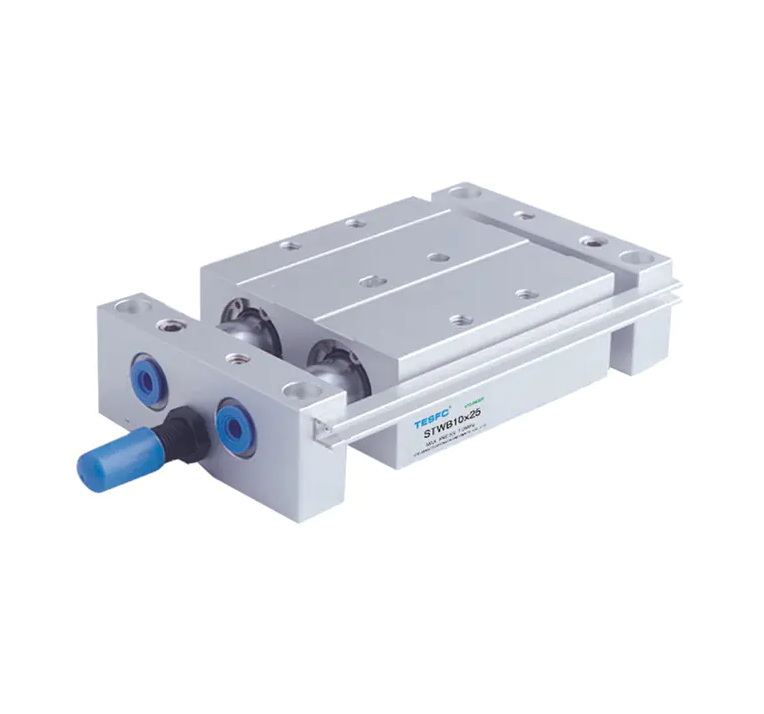
This is where the design of a double shaft air cylinder becomes interesting.
A conventional cylinder can provide linear movement, but some applications also need better support around the moving part. A double shaft structure brings another way to approach this requirement. By using two shafts as part of the moving arrangement, the cylinder can support guided movement while remaining relatively compact.
The idea is not new in principle, but its role in modern equipment design deserves closer attention. As manufacturers look for practical ways to organize machine layouts, components that combine movement and guidance can become useful design options.
Linear movement looks simple from the outside. A component moves forward, stops, and returns. Yet the surrounding structure can make the task much more complicated.
The moving part may need to maintain its position while carrying another component. It may also need to approach an object from a particular direction. If the movement is not properly supported, unwanted movement can affect the way connected parts interact.
Guided linear motion helps address this design concern.
Instead of allowing a moving component to travel with limited support, the structure provides a clearer path. This can make the motion easier to organize within a machine.
Guidance can matter in many situations:
The key point is that movement and guidance often need to work together. A cylinder may provide the force for movement, but the surrounding structure determines how that movement behaves.
This is why double shaft air cylinders attract attention. Their structure brings movement and guidance closer together within one component arrangement.
It uses two shafts to help guide the moving section. The two shafts work together with the cylinder body and moving plate to create a more supported linear path.
This arrangement can be useful when the moving load needs more support than a simple single-shaft design can comfortably provide.
Imagine a small machine that needs to push a component forward. The pushing surface is wider than the central shaft of a conventional cylinder. A single shaft may provide the required movement, but the connected plate may need additional support to remain aligned.
A double shaft arrangement offers another approach.
The moving plate can connect to both shafts. As the cylinder moves, the two shafts travel together. This gives the attached component a broader support arrangement.
The benefit is not simply the presence of two shafts. The overall design can help distribute the movement across a wider area. This can make the moving section easier to integrate with other machine parts.
It also gives designers another way to think about motion.
Instead of treating the cylinder only as a source of force, they can consider it as part of the guided movement structure.
Space is a constant consideration in equipment design. A machine may have many moving parts competing for the same area. Adding separate components for movement and guidance can make the layout more complicated.
It can offer a more integrated approach.
The cylinder provides the movement while its shaft arrangement also supports the moving plate. This may reduce the need to design a completely separate guiding arrangement for certain applications.
That does not mean a double shaft cylinder can replace every external guide. Different machines have different movement requirements. Load conditions, installation methods, operating environments, and connected components all affect the final design.
Still, the integrated concept can be useful.
| Design Consideration | Possible Role of a Double Shaft Air Cylinder |
|---|---|
| Limited Installation Space | Combines movement and support within a compact arrangement |
| Wider Moving Plate | Provides support at more than one point |
| Repeated Linear Movement | Offers a consistent path for connected components |
| Compact Automation | Can fit naturally into smaller machine layouts |
| Simple Pushing Operations | Supports the moving element during travel |
| Equipment Integration | Provides a convenient connection point for other parts |
This can be particularly relevant to compact automation equipment. When every part of a machine has to fit within a carefully planned space, component integration becomes an important design consideration.
The potential applications are broad because linear movement appears in many forms of machinery.
Small automated systems may use cylinders to move fixtures, holders, workpieces, covers, or positioning components. Packaging equipment can also involve repeated pushing and positioning actions. Assembly equipment may need to bring parts together along a defined path.
In these situations, the cylinder is not working alone. It becomes part of a larger movement system.
It can be considered where the moving component needs support during travel.
For example, a compact handling device may use a moving plate to carry an attached tool. The plate needs to travel along a defined path. A double shaft structure can provide a practical connection between the pneumatic movement source and the moving section.
Another example is a small pressing mechanism. The pressing element may be broader than the cylinder shaft itself. A double shaft design can provide a more balanced connection to the moving plate.
There are also applications involving sliding covers, material positioning, inspection fixtures, and small transfer mechanisms.
The important question is not simply, "Can this cylinder move the part?"
A better question is, "How should the moving part be supported while it travels?"
That shift in thinking can help equipment designers choose components according to the whole movement task rather than one function alone.
The moving plate is often an important part of the overall arrangement. It connects the cylinder movement with the component that needs to travel.
If the plate is small and the movement task is straightforward, the design may be relatively simple. A wider plate or an attached component can create different requirements.
A plate can carry a fixture, holder, guide, clamp, sensor, or other machine element. Its movement needs to remain coordinated with the cylinder.
The two-shaft structure gives the plate support from more than one location. This can make the connection more suitable for applications where a central shaft alone does not provide the desired arrangement.
It also changes how designers can position connected components.
Rather than building every moving section around a single central point, designers can work with a wider support structure. This can help when the attached part has a broader shape.
The design may also help reduce unnecessary complexity around the moving section. Fewer separate elements can sometimes make the machine easier to organize.
However, simplicity should not be confused with universal suitability. A air cylinder still needs to match the movement task. The connected load, working direction, installation conditions, and required motion all need consideration.
Not every application needs the same type of guidance.
Some machines may already have an external guiding structure. In that case, the cylinder mainly needs to provide movement. Other equipment may have limited space and benefit from a cylinder arrangement that includes additional support.
This creates an important design choice.
A separate guide gives designers more freedom to place the guidance mechanism independently from the cylinder. It can be useful for larger or more complicated movement systems.
An integrated cylinder arrangement can be attractive when the movement area is compact and the machine layout benefits from fewer separate components.
The choice can be considered through several practical questions:
What is moving?
A small component may have different needs from a broad fixture or platform.
How much support is needed?
Some moving elements need more stable support during travel.
How much installation space is available?
A compact layout may favor an integrated approach.
What other components connect to the moving plate?
The shape and position of attached parts can influence the arrangement.
Does the machine already have a guiding structure?
Existing guidance may make an additional integrated arrangement unnecessary.
Thinking about these questions early can help avoid unnecessary redesign later.
Compact automation is changing how equipment designers approach machine architecture. Smaller machines do not necessarily perform fewer tasks. They often need to combine more functions within a limited footprint.
This creates pressure on every component.
A cylinder needs to provide movement. A guide needs to maintain direction. A connection needs to hold attached parts in place. When several functions can be considered together, the overall layout may become easier to manage.
It fit into this discussion because their design naturally connects several movement-related functions.
They can be used in small handling mechanisms, positioning equipment, assembly devices, packaging machinery, and other automated systems where controlled linear movement is required.
The attraction is not based on a single feature. It comes from the way the component can fit into a broader machine design.
This also reflects a wider change in manufacturing.
Equipment development is moving toward more integrated structures. Designers are looking at how components interact instead of evaluating each part separately. A cylinder is no longer viewed only as something that moves back and forth. Its shape, mounting method, moving plate, and relationship with nearby parts can all affect the final machine.
Choosing a cylinder should begin with the application rather than the component itself.
The movement direction is an important starting point. The designer should understand where the moving section needs to travel and what it needs to carry.
The attached part also deserves attention. A moving plate with a broad fixture may require a different support arrangement from a small attachment.
Installation conditions matter as well. Available space, mounting position, surrounding components, and maintenance access can all influence the practical choice.
The operating environment should not be overlooked. Dust, moisture, temperature, cleaning practices, and other workplace conditions can affect how a pneumatic component fits into the machine.
Maintenance is another consideration. A component that is easy to access can make routine inspection and replacement more manageable.
Designers should also consider how the cylinder interacts with other parts. The moving section should have enough room to travel without interfering with nearby structures. Connections should be planned before the machine is assembled.
A useful design review can therefore include:
These considerations help place the cylinder within the real application instead of evaluating it as an isolated product.
The growing interest in compact equipment is encouraging designers to reconsider how machine functions are divided.
Movement, guidance, support, and connection do not always need to exist as completely separate elements. Sometimes they can be brought closer together through component design.
It provide one example of this approach.
Their value may come from giving designers another way to organize linear movement. Instead of adding guidance only after the movement system has been planned, designers can consider the guided motion requirement at the beginning of the layout process.
This can change the design conversation.
A machine builder may begin by asking how much space is available. Then the discussion can move toward the size of the moving plate, the position of the connected component, and the way the motion should be supported.
That approach is more holistic.
It also encourages closer cooperation between mechanical design and automation planning. A small change in the cylinder arrangement can influence the position of nearby parts. A different moving plate can affect how the machine frame is organized. A more compact movement section can create additional room for other functions.
As equipment continues to combine more operations within smaller working areas, these relationships will remain important.
Double shaft air cylinders are therefore worth considering not simply as pneumatic components, but as part of a broader discussion about guided linear motion, compact layouts, and practical machine architecture.
RECOMMENDED PRODUCTS

Phone: +86-15957736756
E-mail: [email protected]
Add: No.7, Yongxing Second Road, Chengdong Industrial Functional Zone, Chengdong Subdistrict, Yueqing City, Zhejiang Province, P.R.China
Copyright © Zhejiang Feishengya Pneumatic Components Co., Ltd. All Rights Reserved.
 Pneumatic Component Factory
 English
 русский
 عربى
عربى Español