/

/

Search
Category
2026-09-18
Industry News
Pneumatic cylinders are widely used when a machine needs controlled linear movement. Air pressure moves a piston inside the cylinder, and that movement is transferred to a piston rod. The basic idea is simple. Yet some applications need more than movement alone.
A moving part may also need to stay aligned. It may need to resist unwanted rotation. It may carry a load that does not sit directly in the center. In these situations, the piston rod may not be the only part responsible for keeping the movement stable.This is where pneumatic cylinder guide rods come into the picture.
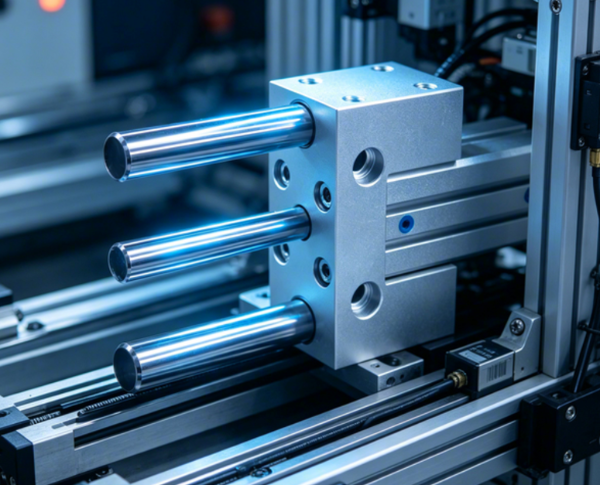
Guide rods are supporting elements arranged alongside the main cylinder movement. They work with a moving plate or similar connection to help control the direction of travel. Depending on the cylinder design, the rods may move through bushings, bearings, or other guiding structures.
The result is a cylinder that can combine pneumatic movement with additional mechanical guidance.
This design is becoming an important part of many automation systems. It can be found in equipment used for pushing, lifting, pressing, holding, stopping, clamping, and material handling. The reason is practical. When a moving load needs to travel in a controlled path, additional guidance can make the overall arrangement easier to manage.
Guide rods are precision-ground steel shafts—typically hardened and hard-chrome plated for wear resistance—mounted parallel to a pneumatic cylinder's main piston rod, running through dedicated linear bushings mounted in the cylinder's head and cap. Their job is purely structural: absorb side load, resist torque, and keep the attached tooling plate traveling in a straight, non-rotating line.
A standard single-rod cylinder relies on one bushing at the rod end to guide the piston rod. That's adequate for pure axial force, centered loads, but it offers very little resistance to torque or off-axis force—apply a side load of even a modest magnitude near the rod's fully extended position, and the resulting moment arm can rapidly exceed what a single bushing was ever designed to handle, leading to rod seal wear, increased friction, and eventually binding or rod scoring.
Adding two guide rods, arranged symmetrically around the main cylinder (the classic twin-rod guided cylinder configuration), spreads that load across three points of support—the two guide rod bushings plus the piston rod itself—dramatically raising the assembly's tolerance for both side load and torque. This is exactly the configuration most manufacturers publish specific load-moment ratings for, typically expressed in Newton-meters or as a maximum side load in Newtons at a given extension distance.
| Part | Main Role |
|---|---|
| Cylinder Body | Provides the main structure for pneumatic movement. |
| Piston | Responds to air pressure inside the cylinder. |
| Piston Rod | Transfers movement outside the cylinder. |
| Guide Rods | Help guide and support the moving assembly. |
| Guide Structure | Keeps the guide rods moving in a controlled path. |
| Moving Plate | Connects the guided movement with the external load. |
The exact construction can vary. Some cylinders use external guide rods. Others integrate guiding parts into the cylinder body. The basic purpose remains similar: separate the guiding function from the simple pushing and pulling action of the piston rod.
The working process starts with compressed air entering the cylinder. The air pushes the internal piston, causing the piston rod to move.
If the cylinder includes guide rods, the external moving section is connected to those rods as well. As the piston rod moves, the guide rods travel through their guiding supports. The moving plate or attached tool therefore follows a controlled path.
The guide rods do not replace the pneumatic cylinder's basic function. Air still provides the driving force. The rods mainly help manage the movement created by that force.
A simple working sequence can be understood in four stages:
Air enters the cylinder.
Pressure acts on the internal piston.
The piston moves.
The piston rod transfers the movement toward the external load.
The guide rods move with the assembly.
Their guiding supports help keep the movement aligned.
The attached part reaches its working position.
The guided structure helps maintain the intended direction during travel.
When the air flow changes, the piston can move in the opposite direction in a suitable cylinder arrangement. The guide rods follow the movement and continue to provide support.
This cooperation is what makes a guided pneumatic cylinder different from a simple cylinder used mainly for straight pushing or pulling.
Plenty of pneumatic applications never need guide rods at all?—a simple centered push, a light clamping action, a basic pilot-operated stop, all of these load a standard cylinder's piston rod within its intended design envelope without issue.
The calculation changes once real off-axis force enters the picture. Take a cylinder pushing a mounting plate carrying a gripper that's picking up parts asymmetrically—the load's center of gravity sits offset from the piston rod's centerline, which creates a moment arm. That moment arm generates torque trying to rotate or tilt the moving assembly, and a standard cylinder's single rod bushing has genuinely limited capacity to resist that torque before seal wear, increased friction, or binding starts showing up in the duty cycle.
Manufacturers publish specific side-load and torque limits for standard cylinders precisely because this failure mode is well understood and predictable—exceed the rated side load at a given stroke extension, and premature wear becomes essentially guaranteed regardless of how well the rest of the system is specified.
Guide rods exist specifically to raise that tolerance. By distributing load across two additional bushing points rather than relying on the piston rod's single bushing alone, a twin-rod guided cylinder can typically handle side loads and torque values many times higher than an equivalent-bore standard cylinder before comparable wear appears.
The real benefit isn't that guide rods make a cylinder "stronger" in some generic sense—it's that they divide the job functionally. The piston rod generates and transfers axial driving force. The guide rods absorb side load and resist rotation. Splitting these functions across dedicated components, each rated for its specific job, is what lets a guided cylinder handle applications a standard cylinder was never built to survive.
Stability is one of the main reasons guide rods are used.
A pneumatic cylinder produces linear movement, but real working conditions can introduce forces from different directions. A load may press against another object. A tool may contact a workpiece. A moving plate may carry something that is not evenly distributed.
These conditions can create unwanted movement.
Guide rods help keep the moving assembly aligned as it travels. Their supporting structure limits unnecessary movement and helps the attached plate follow the intended path.
This can also help with orientation.
For example, a tool mounted to the moving plate may need to remain facing the same direction throughout the stroke. Without suitable guidance, the tool may have a tendency to turn or shift. A guide rod arrangement can help control that movement.
The relationship can be viewed simply:
Pneumatic force → piston movement → piston rod movement → guided moving plate → controlled external movement
The guide rods are part of the middle of this process. They do not create the pneumatic force. They help make better use of the movement created by the cylinder.
This distinction is important when selecting equipment. A buyer should not assume that adding guide rods solves every movement problem. The entire application still needs to be considered.
Guided pneumatic cylinders can be useful in many situations where a machine needs controlled linear movement.
Material handling is one common area. A guided cylinder may push, lift, stop, or position an item as part of a larger machine. The guide structure helps keep the moving part stable while it interacts with the material.
Packaging equipment can also use guided movement. A machine may need to move a plate, press a package, position an item, or separate products. The exact task changes from one machine to another, but controlled movement remains important.
The common factor is not the industry itself. It is the type of movement required.
When a machine needs a moving part to travel along a defined path while remaining stable, guide rods can become useful.
This is why the same basic concept can appear in different types of equipment. The application may change, but the need for controlled linear movement remains.
The main difference is the way the moving load is supported and controlled.
A standard pneumatic cylinder is generally designed around a piston, piston rod, and cylinder body. Its main task is to generate linear movement. The external load needs to be suitable for that arrangement.
A guided cylinder adds a separate guiding structure. The guide rods work alongside the piston rod to support the moving assembly.
| Feature | Standard Pneumatic Cylinder | Pneumatic Cylinder with Guide Rods |
|---|---|---|
| Main Purpose | Create linear movement | Create and guide linear movement |
| External Guidance | May depend on the machine | Guidance is built into or attached to the cylinder |
| Rotation Control | Depends on the application | Additional guidance can limit unwanted rotation |
| Side Forces | Need careful consideration | Guide structure can provide additional support |
| Typical Use | Simple pushing and pulling | Guided pushing, lifting, holding, positioning, and handling |
This does not mean that guided cylinders should replace standard cylinders in every machine.
A simple task may not require additional guiding. Adding unnecessary components can make a system more complicated than it needs to be.
The better approach is to look at the actual working conditions. If the load needs additional support or the moving part must maintain its orientation, a guided arrangement may make more sense.
Choosing a guided pneumatic cylinder starts with the application rather than the product name.
Buyers should understand what the cylinder will do during normal operation. The type of load, direction of movement, working environment, available installation space, and required level of guidance can all affect the choice.
A useful checklist can include:
1. What is being moved?
Identify the general type of load and how it connects to the moving plate.
2. How will the load move?
Consider whether the movement involves pushing, lifting, pressing, holding, or another task.
3. Could the load create side forces?
If the load does not remain centered, additional guidance may become more important.
4. Does the moving part need to stay in one orientation?
If rotation would affect the application, guide rods can provide useful control.
5. What is the working environment?
Dust, moisture, cleaning processes, and other environmental conditions may influence the suitable cylinder design.
6. How will the cylinder be installed?
The available space and mounting arrangement should be considered before choosing a cylinder.
7. How will the cylinder be maintained?
The guide rods and their supporting parts should remain accessible enough for inspection and routine care.
A clear application description can make the selection process easier. Instead of simply asking for a pneumatic cylinder with guide rods, buyers can explain what the moving assembly needs to accomplish.
That gives manufacturers and equipment designers a better basis for discussing suitable options.
Guide rods are relatively simple parts, but their position inside a machine can make them important to daily operation.
A guided cylinder needs the rods, moving plate, and supporting structure to work together. If the moving assembly is not properly aligned, the cylinder may experience unnecessary resistance. Dirt or damage around the guiding area can also affect movement.
Routine attention can therefore make a difference.
Operators can observe whether the moving assembly travels smoothly. They can check for unusual movement, visible contamination, loose connections, or changes in the way the cylinder behaves during normal work.
Maintenance does not always need to involve complicated procedures. It can begin with simple observation.
The surrounding machine should also be considered. A guide rod can only provide useful guidance when the parts connected to it are installed and used appropriately. Excessive external force, poor alignment, or an unsuitable load can create problems that the guide rods were not intended to solve.
For this reason, guide rods should be viewed as part of a complete movement system rather than as an isolated component.
Their value comes from cooperation.
The cylinder supplies the movement. The piston rod transfers that movement. The guide rods help control the moving assembly. The attached tool or load then follows the guided path.
When these parts are selected around the same application, pneumatic movement becomes easier to connect with the practical needs of the machine.
RECOMMENDED PRODUCTS

Phone: +86-15957736756
E-mail: [email protected]
Add: No.7, Yongxing Second Road, Chengdong Industrial Functional Zone, Chengdong Subdistrict, Yueqing City, Zhejiang Province, P.R.China
Copyright © Zhejiang Feishengya Pneumatic Components Co., Ltd. All Rights Reserved.
 Pneumatic Component Factory
 English
 русский
 عربى
عربى Español