/

/

Search
Category
2026-09-25
Industry News
Precision automation is changing how manufacturers think about machine movement.
In the past, automated equipment often had to focus on completing a task repeatedly. Today, the way a machine performs that task can matter just as much. Movement needs to be controlled. Components need to work together. Small differences in motion can affect the next stage of production.This shift is bringing more attention to the devices that create and control movement.
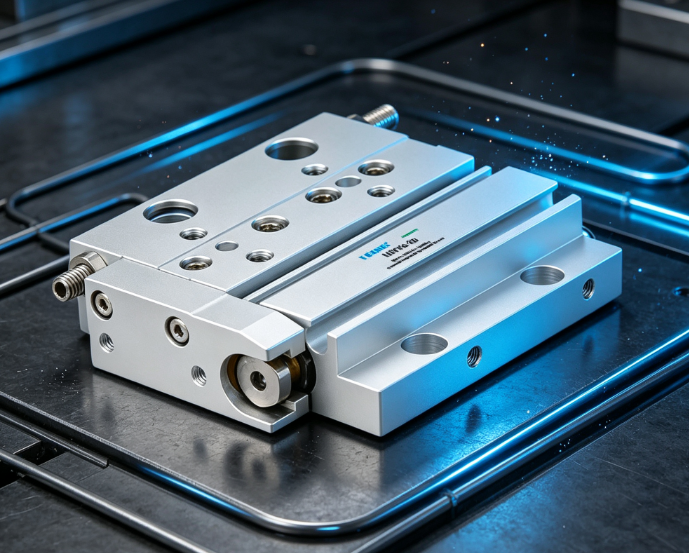
Ultra precision air cylinders are part of this discussion. They provide linear movement through compressed air and are used in equipment where controlled motion is important. Their role is not limited to simply pushing, pulling, lifting, or positioning a component. In a carefully designed automation system, an air cylinder can become part of a wider movement strategy.
As production equipment becomes more compact and processes become more closely coordinated, the relationship between pneumatic movement and precision automation is becoming more important.
Automation is often associated with speed and repeatability. Yet modern production needs involve more than making a machine move again and again.
A machine may need to place a component, hold an item, separate materials, close a fixture, or move a part into another working area. Each action can affect what happens next. If movement is inconsistent, the following process may also become less predictable.
This is especially relevant when several automated actions take place within a limited space. A movement that appears simple from the outside may need to fit closely with other mechanical actions.
Precision therefore becomes part of the overall equipment design.
Manufacturers are also looking at how machines interact with products. Some products are small or delicate. Others require careful handling because their position affects the next operation. In these situations, uncontrolled or inconsistent movement may create unnecessary problems.
This does not mean that every automated machine requires an ultra precision air cylinder. The choice depends on the application. But as automation systems become more coordinated, there is greater interest in movement components that can support controlled and repeatable operation.
| Automation Need | Why Controlled Movement Matters |
|---|---|
| Component Positioning | Helps keep parts in a consistent working area |
| Repeated Handling | Supports predictable movement from one cycle to another |
| Assembly Operations | Allows different actions to work together |
| Product Transfer | Helps reduce unnecessary movement |
| Compact Equipment | Makes better use of limited machine space |
| Inspection Processes | Supports controlled positioning before inspection |
The change is not simply about making a cylinder more precise. It is about giving machine designers more control over how movement fits into the complete process.
An air cylinder may look like a relatively simple component. Its basic role is to create linear movement. In an automated machine, however, that movement can be connected to several other actions.
A cylinder may move a fixture into position. Another device may then perform an operation. Afterward, the cylinder may return the fixture to its previous location. The movement itself becomes one part of a larger sequence.
This is where ultra precision air cylinders can attract attention.
Their value is related to controlled motion rather than movement alone. When the movement of one component needs to match the position or timing of another component, consistency becomes an important consideration.
This can also affect machine design. Engineers may have more freedom to arrange components around a defined movement path instead of treating the pneumatic cylinder as an isolated part.
The role of the cylinder can vary widely between applications.
It may support:
The same basic principle applies across these applications. The cylinder provides movement, while the surrounding machine determines how that movement is used.
This distinction matters when discussing precision automation. An air cylinder alone does not make an entire machine precise. Machine structure, control methods, component selection, product characteristics, and operating conditions all influence the final result.
Ultra precision air cylinders are better understood as one part of that larger system.
The demand for controlled movement can appear in many areas of industrial production.
Small automated machines are one example. When equipment has limited space, every movement needs to fit into the available working area. Unnecessary travel can make the machine harder to organize. Controlled linear movement can help designers create a more orderly sequence.
Assembly equipment is another area.
During assembly, a component may need to be moved into a defined position before another action takes place. The movement does not need to be dramatic. In many cases, a small and consistent action is more useful than a fast one.
Inspection equipment also has a similar requirement. Before an item can be checked, it may need to be moved into a suitable position. The positioning process can influence how easily the inspection step is carried out.
Material handling provides another application.
A production line may involve repeated transfers between different stages. The movement can involve trays, parts, fixtures, or other items. A pneumatic cylinder can provide a relatively straightforward way to move these items through a defined path.
There is also growing interest in automation that combines several different movement methods. Electric drives, pneumatic systems, mechanical structures, sensors, and control systems can all appear within the same machine.
This means pneumatic components are not necessarily competing with every other form of motion. In many cases, they are being selected according to the particular movement a machine needs.
Flexibility has become an important part of equipment planning.
Production environments can change. Product types may vary. A machine may need to handle different components or perform more than one operation. This puts pressure on designers to create equipment that can accommodate different working conditions.
Controlled pneumatic movement can support this approach when the application suits it.
For example, a machine may use a cylinder to move a component between two working positions. The surrounding equipment can then be arranged around that movement. If the movement needs to be adjusted for a different task, the machine can be designed with that possibility in mind.
Compactness is another consideration.
Modern equipment does not always have unlimited floor space. Manufacturers may want to place more functions within a smaller machine footprint. This creates a need for careful component placement.
An air cylinder can become part of this space planning.
Rather than viewing the cylinder only as a source of force, designers can consider its position, movement path, connection with other components, and role in the production sequence.
This broader approach can change how pneumatic systems are designed.
The question is no longer simply, "Can the cylinder move this part?"
It becomes:
"How should this movement fit into the complete machine?"
That shift in thinking is one reason precision air cylinders are becoming more relevant to modern automation discussions.
A machine can move quickly and still produce an uneven process.
Repeated movement is easier to manage when each cycle follows a predictable pattern. This becomes particularly important when one machine action depends on another.
Imagine a production process in which a part needs to be moved into position before another component interacts with it. If the position changes from one cycle to another, the following operation may also be affected.
The issue may not always be obvious.
Small differences can accumulate through a sequence of automated actions. A positioning step may influence assembly. Assembly may affect inspection. Inspection may determine whether a product moves to the next stage.
This creates a chain of movement.
For this reason, precision automation is increasingly concerned with consistency across the whole process. The objective is not simply to make one movement accurate in isolation. The movement needs to make sense within the wider machine.
Ultra precision air cylinders can be considered in this context.
They can provide controlled linear motion where a standard movement solution may not fit the requirements of the application. The final result still depends on the complete equipment design, but the cylinder can play an important role within that structure.
This is also why application assessment matters.
A cylinder that works well in one machine may not be suitable for another. The product being handled, movement pattern, available space, surrounding equipment, and operating environment all need to be considered together.
Pneumatic systems have been part of industrial automation for a long time. What is changing is the way designers are integrating them into modern equipment.
Instead of treating pneumatic components as separate utility parts, designers can consider them as part of the machine's overall movement architecture.
That approach encourages several questions:
What movement is actually required?
A machine does not necessarily need complex movement for every operation. A simple linear action may be suitable when the task is clearly defined.
How does the movement interact with other processes?
The cylinder may need to work alongside sensors, fixtures, handling devices, or other motion components. The surrounding system should be considered during selection.
How repeatable is the operation?
Repeated production creates repeated movement. Consistency becomes more important when a movement is performed many times during daily operation.
How easy is the system to maintain?
A precision application still needs practical maintenance. Designers need to think about access, inspection, replacement, and general machine service.
This broader design process can make the selection of an air cylinder more deliberate.
It also creates room for more application-specific solutions. Instead of selecting a cylinder simply because it can produce the required movement, manufacturers can consider how its characteristics fit the actual production task.
Choosing an air cylinder for a precision application involves more than looking at the word "precision."
The actual working conditions matter.
The movement required by the machine should be clearly understood. The cylinder may need to move a component through a specific sequence or work alongside other machine functions. Its physical arrangement also needs to fit the equipment.
The handled product is another important factor. A fragile component may require a different movement approach from a robust industrial part. The machine's operating environment can also influence the selection.
Maintenance should remain part of the discussion.
A precision component still operates within a real production environment. Dust, repeated use, surrounding equipment, cleaning routines, and general machine conditions can all influence long-term operation.
Manufacturers may therefore consider several areas before making a selection:
| Selection Area | Key Question |
|---|---|
| Application | What movement does the machine actually need? |
| Product | What type of item will be handled? |
| Space | How much room is available around the movement? |
| Coordination | What other machine actions must work with the cylinder? |
| Maintenance | How will the component be inspected and serviced? |
| Integration | How will the cylinder fit into the complete automation system? |
This approach keeps the focus on the application rather than on a single product feature.
Precision is useful only when it addresses a real requirement.
Automation continues to move toward greater coordination between individual machine functions.
As equipment becomes more compact, more operations may need to share the same working area. As product handling becomes more controlled, movement may need to become more predictable. As production systems become more flexible, individual components may need to fit into a wider range of machine designs.
These changes can create new opportunities for precision pneumatic movement.
Ultra precision air cylinders are unlikely to replace every other type of motion solution. Different machines have different needs. Some applications may be better suited to other forms of actuation or a combination of several technologies.
The more interesting development is the way these options can work together.
A modern machine may use pneumatic movement for one task and another form of motion for a different task. Sensors can provide information. Control systems can coordinate actions. Mechanical structures can guide movement. Each part contributes to the way the equipment operates.
Within this environment, an ultra precision air cylinder is not simply a pneumatic component.
It can be part of a carefully planned movement system.
That perspective helps explain why interest in precision air cylinders continues to grow. The discussion is moving beyond whether a cylinder can create motion. It is increasingly about whether that motion can fit naturally into the needs of a precise, compact, coordinated, and adaptable automation system.
RECOMMENDED PRODUCTS

Phone: +86-15957736756
E-mail: [email protected]
Add: No.7, Yongxing Second Road, Chengdong Industrial Functional Zone, Chengdong Subdistrict, Yueqing City, Zhejiang Province, P.R.China
Copyright © Zhejiang Feishengya Pneumatic Components Co., Ltd. All Rights Reserved.
 Pneumatic Component Factory
 English
 русский
 عربى
عربى Español