/

/

Search
Category
2026-10-02
Industry News
When a machine needs more working force but has limited installation space, engineers often face an awkward design problem. Making a conventional pneumatic cylinder larger can increase available force, but it may also affect the machine layout, mounting structure, response, and overall equipment footprint. An Air Hydraulic Booster Cylinder takes a different approach by combining compressed air with hydraulic force amplification inside a compact actuator structure.
This principle is useful in automated pressing, clamping, riveting, forming, punching, and assembly equipment. Instead of depending only on a larger air chamber, the system uses pneumatic energy to drive a hydraulic intensification process. The result is a way to obtain higher working force from a relatively compact actuator design.
Understanding how this works can help machine builders decide when a gas-liquid booster cylinder makes sense and when a conventional pneumatic actuator is still sufficient.
In a conventional pneumatic system, output force is closely related to the effective piston area and the supplied air pressure. If the required force increases, one common approach is to select a cylinder with a larger bore.
That solution is straightforward, but it can create secondary design issues.
These factors become more noticeable in compact automation equipment.
For example, an assembly machine may have enough room for a relatively small actuator, but not enough room for a much larger pneumatic cylinder. A fixture may also need a significant working force while keeping its structure narrow and accessible.
This is where force amplification becomes interesting.
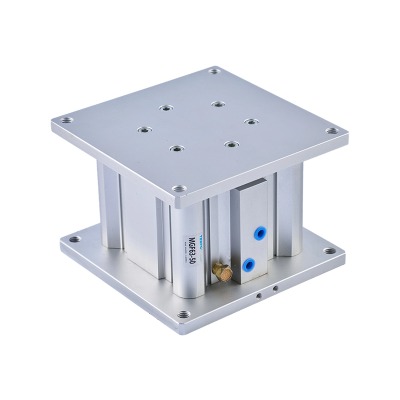
The basic idea is easier to understand when the pneumatic and hydraulic sections are considered separately.
Compressed air provides the initial driving energy. Instead of using that air pressure directly as the final working force, the actuator transfers the input through a hydraulic medium.
The internal mechanism then creates a pressure intensification effect.
The operating sequence can be described in several stages:
The important point is that the output is not based simply on the original pneumatic pressure acting over the original piston area.
The internal area relationship and hydraulic transmission mechanism allow the actuator to generate a different force level from the initial pneumatic input.
This is why a gas-liquid design can provide a practical alternative when a standard air cylinder would need a larger body to achieve a similar working requirement.
Air is compressible, which is useful for fast pneumatic movement but can also influence how an actuator behaves under load.
Hydraulic fluid behaves differently. It transfers pressure through a liquid medium with much less compressibility under normal operating conditions.
By bringing the two principles together, the actuator can use compressed air for the driving side while relying on hydraulic transmission during the force-intensive part of the operation.
This hybrid structure is particularly useful when a machine needs a combination of:
The actual performance still depends on the complete machine design, operating conditions, actuator configuration, and control system.
A larger pneumatic cylinder can certainly be appropriate in many applications. The question is whether increasing cylinder size is the practical way to solve the force requirement within the available machine layout.
Consider a compact assembly station.
The machine may already contain:
Adding a larger cylinder can interfere with other components or require changes to the frame.
A booster cylinder offers another design route. Rather than increasing the actuator's external dimensions simply to obtain more force, engineers can use internal pressure intensification to increase the available working force.
That does not mean the booster design should replace every conventional pneumatic cylinder. It means there is another option when force density and installation space become important design considerations.
The working principle becomes easier to appreciate when looking at actual machine tasks.
Pressing applications often require a defined amount of force during part insertion or joining.
Examples can include:
A conventional pneumatic cylinder may be adequate for lighter operations. When the required force increases while machine space remains restricted, a gas-liquid booster configuration can become a consideration.
The key is to match the actuator to the actual resistance created by the workpiece and tooling.
Clamping systems need enough force to keep a workpiece stable without damaging it.
A booster actuator can be integrated into fixtures where the available installation space is limited but the clamping task requires a relatively concentrated force.
The mechanical fixture remains important. The cylinder does not work in isolation.
Engineers should consider:
A suitable actuator paired with an appropriate fixture can create a more practical automated clamping arrangement.
Automated riveting requires controlled force and repeatable movement.
The actuator needs to work together with the riveting mechanism, tooling, guide structure, and control system. A compact force-generating cylinder can be useful when the machine requires a concentrated working action without adding a large pneumatic body.
Light punching, marking, forming, bending, and crimping processes may also use this type of actuation.
However, engineers should avoid selecting an actuator simply because a catalog description lists a particular application.
The actual material, tooling geometry, resistance, stroke, duty cycle, and machine structure all need to be evaluated.
Space is becoming an increasingly important part of machine design.
Modern automation equipment often needs to combine more functions inside a restricted footprint. An actuator therefore has to fit not only the force requirement but also the physical architecture of the machine.
A compact force-oriented cylinder can provide several layout benefits.
A smaller actuator body can give designers more freedom around fixtures, tooling, sensors, and other components.
This can be particularly useful in:
Equipment modification is another situation where size matters.
Suppose an existing pneumatic machine requires additional working force. Rebuilding the entire machine around a larger actuator may not be practical.
A gas-liquid booster design can sometimes provide another route, provided that the available mounting space, air supply, stroke, load direction, and mechanical structure are compatible.
The decision should always be based on the complete system rather than cylinder size alone.
The force amplification principle explains why these actuators can be useful, but it does not remove the need for careful selection.
Several factors deserve attention before a cylinder is integrated into a machine.
Start with the actual process.
Is the actuator pressing, clamping, riveting, forming, punching, or positioning?
Calculate the resistance created by the workpiece and tooling instead of selecting the actuator from a general application name.
It is also useful to consider friction, mechanical losses, load variation, and the working direction.
The stroke should correspond to the actual movement needed by the machine.
A longer stroke is not automatically useful. Unnecessary travel can affect cycle timing and mechanical arrangement.
The working stroke should be considered together with:
Measure the actual mounting area before confirming a configuration.
Pay attention to:
A cylinder that fits on paper may still create problems if there is insufficient access around it.
Although the force-intensive process uses hydraulic amplification, the pneumatic side remains an important part of the system.
The machine should provide a suitable and stable compressed-air supply.
Engineers should also consider:
Poor air preparation can affect pneumatic components throughout the system, not only the booster cylinder.
This point is easy to overlook.
Actuators are designed to work along their intended force direction. Excessive side loading can place additional stress on the rod, seals, guide elements, and mounting structure.
If the machine creates a side load, engineers should consider external guides or an appropriate guided mechanism rather than expecting the cylinder rod to absorb the unwanted force.
The difference becomes clearer when the two approaches are viewed from a machine design perspective.
| Design Consideration | Conventional Pneumatic Cylinder | Gas-Liquid Booster Design |
|---|---|---|
| Basic drive | Compressed air | Compressed air with hydraulic force amplification |
| Typical role | General linear movement | Force-intensive pneumatic applications |
| Force strategy | Increase piston area or pressure within system limits | Use internal pressure intensification |
| Space consideration | Larger force may require a larger cylinder | Compact force generation can be considered |
| System integration | Standard pneumatic circuit | Pneumatic control with gas-liquid actuation |
| Common tasks | Movement, positioning, pushing | Pressing, clamping, riveting, forming |
| Selection focus | Bore, stroke, pressure, speed | Force requirement, stroke, space, load, control |
Neither structure is suitable for every machine.
A conventional pneumatic cylinder may be entirely appropriate when the required force is moderate and the available space is sufficient. A booster configuration becomes more relevant when the machine needs concentrated force without simply increasing the external cylinder size.
No actuator should be selected from one feature alone.
A gas-liquid design introduces a more specialized internal structure than a basic pneumatic cylinder. That means engineers should consider the complete operating environment.
The machine design should account for:
This broader view helps prevent a common engineering mistake: choosing a component because it solves one problem while creating another.
For example, gaining additional force is useful, but not if the actuator cannot fit the fixture. A compact body is helpful, but not if the working stroke is unsuitable. A suitable force level is important, but the machine also needs appropriate guides and tooling.
Good actuator selection is therefore a system-level decision.
Automation equipment is becoming increasingly integrated. A single machine may combine feeding, positioning, pressing, inspection, assembly, and transfer functions in a relatively compact structure.
That creates pressure on mechanical designers to use available space carefully.
At the same time, many production tasks still need concentrated mechanical force.
This creates an interesting design gap between a conventional pneumatic actuator and a complete hydraulic system.
Gas-liquid booster technology addresses that gap by combining pneumatic operation with hydraulic force amplification.
For machine builders, the attraction is not simply the force itself. It is the possibility of balancing several requirements within one actuator concept:
Compact structure + pneumatic control + concentrated working force + flexible machine integration
That combination makes the technology relevant to equipment manufacturers working on pressing, joining, clamping, forming, and automated assembly systems.
Instead of starting with the question, "Which cylinder should I buy?", it can be more useful to begin with the machine problem.
Ask:
Once these questions are answered, the suitable actuator structure becomes easier to identify.
This approach also gives manufacturers clearer information when discussing a customized or application-specific cylinder with a pneumatic component supplier.
The key concept is relatively simple.
A standard pneumatic cylinder uses compressed air to create mechanical force directly. When higher force is required, increasing the effective piston area is one possible solution.
A gas-liquid booster cylinder takes another path.
Compressed air provides the initial movement, while hydraulic pressure transmission and internal force amplification increase the working output. Because the amplification mechanism is integrated into the actuator structure, the machine does not necessarily need to rely on a much larger pneumatic cylinder.
That makes the technology particularly relevant to equipment where available space, working force, and pneumatic control all need to be considered together.
For engineers, the important question is therefore not whether a booster cylinder is automatically suitable for a machine. The better question is whether the application's force requirement, movement, installation space, load conditions, and control system match the characteristics of gas-liquid actuation.
When those factors align, this type of actuator can provide a practical design option for compact automated equipment.
RECOMMENDED PRODUCTS

Phone: +86-15957736756
E-mail: [email protected]
Add: No.7, Yongxing Second Road, Chengdong Industrial Functional Zone, Chengdong Subdistrict, Yueqing City, Zhejiang Province, P.R.China
Copyright © Zhejiang Feishengya Pneumatic Components Co., Ltd. All Rights Reserved.
 Pneumatic Component Factory
 English
 русский
 عربى
عربى Español