/

/

Search
Category
2026-11-13
Industry News
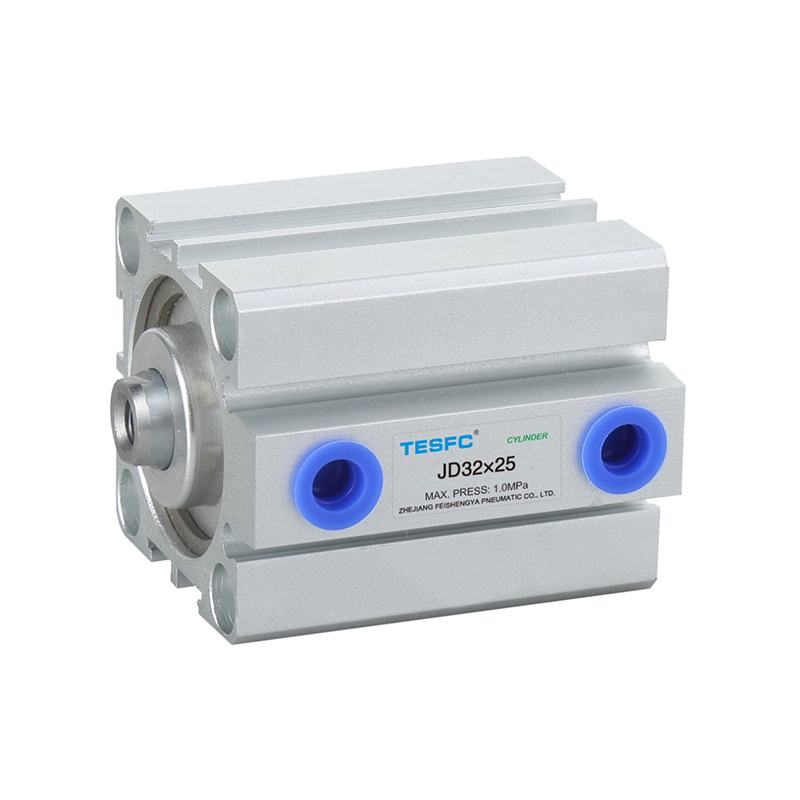
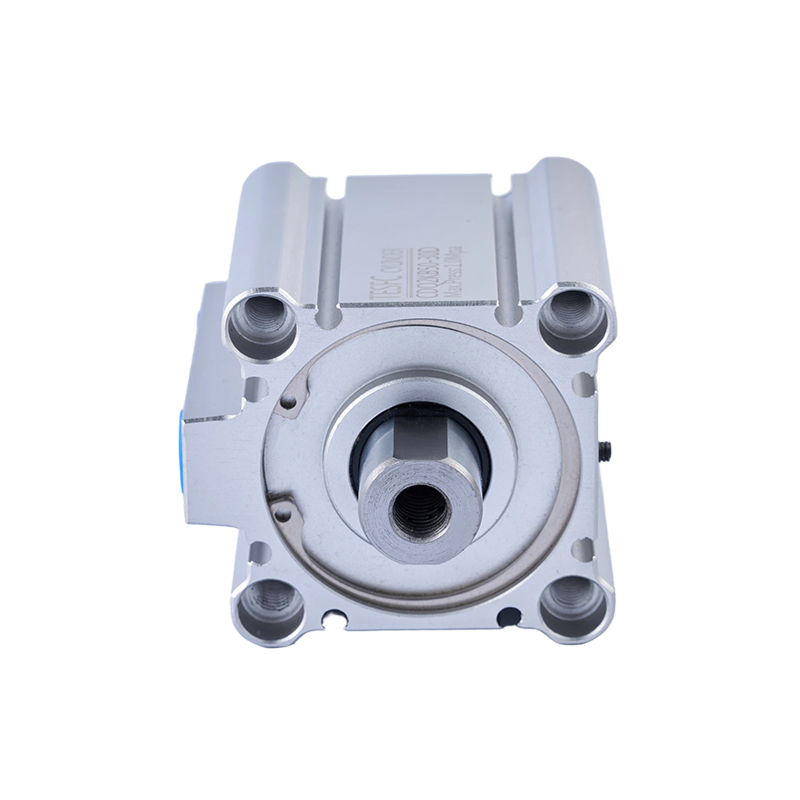
Pneumatic cylinders convert compressed air into linear motion for pushing, pulling, clamping and positioning tasks on automated machinery. Standard designs prioritise bore, stroke and mounting style, and often leave position sensing to external mechanisms or omit it entirely. The ACQ-SB magnetic ultra thin air cylinder combines a short axial body with a piston that carries a magnetic element so that compatible sensors can read end positions or intermediate points along the stroke. Those two choices—reduced thickness and built-in magnetism—set it apart from many general-purpose cylinders that are longer in the axial direction and lack a magnetic piston for switch detection.
The model is intended for equipment layouts where every millimetre of depth matters and where the control system needs a simple, non-contact indication that the piston has arrived. It remains a pneumatic actuator first: air ports, seals and mounting still follow normal pneumatic practice. The difference lies in how little space the body claims and in how position feedback is obtained without redesigning the machine around external transducers.
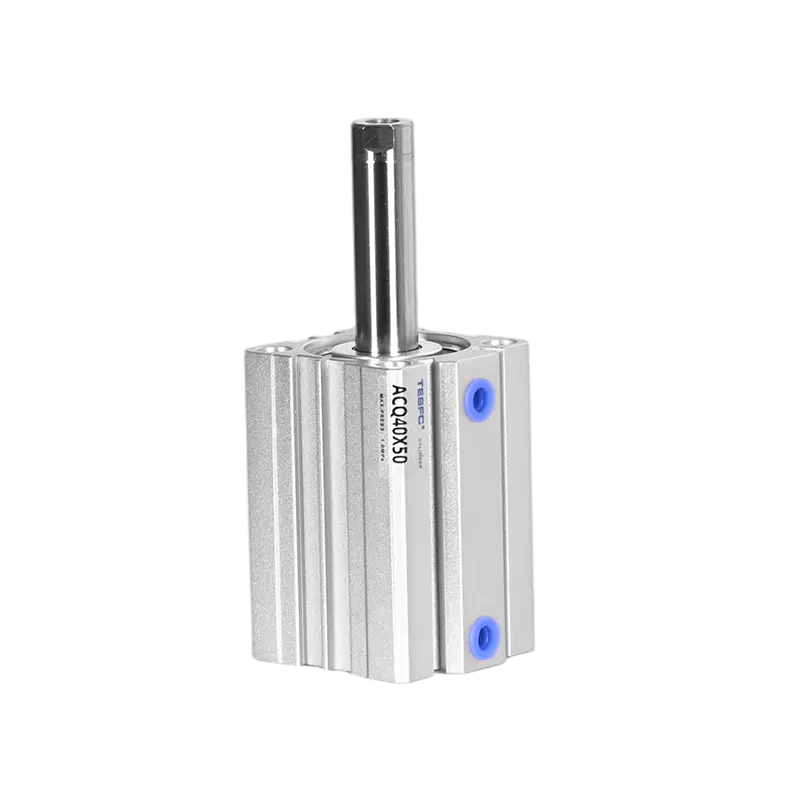
An ultra-thin cylinder shortens the dimension along the axis of motion relative to many standard tie-rod or round-body designs of similar bore. That reduction frees space in shallow cavities, between parallel plates and inside compact modules where a longer barrel would collide with covers, wiring ducts or neighbouring actuators. Machinery with limited clearance—desktop automation, thin fixtures and densely packed tooling plates—benefits when the cylinder no longer determines the required stack height of the assembly.
Space savings apply only within the published envelope of the actual model. Mounting faces, port bosses and switch rails still need room. Designers verify overall length at full stroke, including any cushioning or end-cap protrusions, rather than assuming the catalogue adjective "thin" alone guarantees fit.
A slim profile simplifies arranging several actuators side by side or stacking functional layers in a small machine frame. Cable routes and pneumatic manifolds can pass closer to the cylinder line without weaving around a bulky barrel. Integration remains subject to real mounting hole patterns, thread sizes and port orientations; drawings for the specific ACQ-SB variant govern hole positions and keep-out zones. When those constraints are respected, the compact structure supports cleaner layouts and shorter structural brackets than a deeper standard cylinder would require.
The piston assembly includes a magnetic component that travels with the piston as air drives the rod or the moving end through its stroke. The magnetic field extends to the outer surface of the tube or to a designated sensing area so that a magnetic switch mounted on the body can detect the field when the piston enters the switch's range. Detection is non-contact: the switch does not rub on the piston, which limits wear on the sensing path. Switch type, mounting style and sensing distance must match the cylinder series; mixed components from unrelated families often fail to pick up a reliable signal.
Compatible magnetic switches can signal extended, retracted or selected intermediate positions to a controller. That feedback supports sequence logic, error trapping and cycle confirmation without adding separate linear encoders for every simple end-of-stroke check. In packaging, assembly and handling equipment, knowing that a clamp has closed or a pusher has returned reduces reliance on timers alone. A Pneumatic Cylinder Magnetic Piston arrangement of this kind is valued when the machine needs discrete position bits rather than continuous analogue stroke measurement.
The ultra-thin body helps meet installation limits where standard axial lengths would force a larger frame or a redesign of neighbouring parts. Compactness is a dimensional property confirmed on the drawing, not a marketing label.
When paired with suitable magnetic sensors, the piston provides a straightforward way to confirm position. Control programs can wait for switch inputs instead of assuming motion completed after a fixed delay.
Pneumatic force and magnetic sensing share one housing. That combination reduces the need for a second device dedicated only to position on short-stroke tasks, subject to the accuracy and repeatability limits of the switch and mounting.
Designers can place the cylinder closer to the work point or inside thinner modules. Port access and switch cable exit still need planning so that service remains possible after the machine is enclosed.
The model can be considered wherever a compact cylinder and magnetic detection are both required, provided bore, stroke, load, speed, pressure range and switch compatibility match the duty. It is not a universal replacement for every standard cylinder, especially where long strokes, heavy side loads or non-magnetic piston preferences apply. A Magnetic Piston Air Cylinder in ultra-thin form is therefore chosen by checklist against the application, not by category name alone.
Standard cylinders without magnetic pistons need external sensors or purely time-based control if position must be known. Standard cylinders with deeper bodies consume more axial space even when magnetic options exist. The ACQ-SB approach addresses both constraints at once: thickness aimed at tight spaces, and a magnetic piston aimed at switch detection. Equipment that must stay shallow and still handshake with a PLC benefits from that pairing. Buyers still confirm mounting dimensions, operating pressure limits, cushioning needs and the exact magnetic switch models approved for the tube and piston combination before releasing designs to build.
| Aspect | Ultra-thin magnetic type | Typical standard cylinder without these features |
|---|---|---|
| Axial space claim | Reduced body depth for shallow layouts | Often longer barrel for same bore class |
| Position sensing | Magnetic piston for compatible switches | External sensors or no sensing |
| Machine integration | Suited to dense, thin assemblies | May force larger frames or brackets |
| Control logic | Discrete feedback at switch points | Timers or separate measurement devices |
| Selection focus | Bore, stroke, switches, mounting envelope | Bore, stroke, mount; sensing added later |
| Limits | Side load, stroke and pressure per catalogue | Same need to respect catalogue limits |
Load must stay within the force available at the working pressure after accounting for friction and orientation. Side loads and moment loads may require guides so that the rod and piston are not forced askew in a short body. Switch positions are set and locked so that vibration does not drift the detection point. Air quality affects seals on all pneumatic cylinders; filtration and lubrication practice follow the product guidance. Periodic checks confirm that switches still actuate cleanly and that mounting bolts remain torque-tight in cyclic service.
The ACQ-SB magnetic ultra thin air cylinder differs from many standard cylinders through a short axial structure for tight installation spaces and a magnetic piston that enables compatible switches to report position. Together those features support shallow equipment layouts and simple automated feedback when specifications for bore, stroke, mounting, pressure and sensors are verified in advance. Zhejiang Feishengya Pneumatic Components Co., Ltd. produces pneumatic actuators including ultra-thin magnetic cylinder configurations for compact automation. Review of dimensional drawings, magnetic switch compatibility and operating limits against the machine design supports selection of a cylinder that fits both the space and the control scheme.
RECOMMENDED PRODUCTS

Phone: +86-15957736756
E-mail: [email protected]
Add: No.7, Yongxing Second Road, Chengdong Industrial Functional Zone, Chengdong Subdistrict, Yueqing City, Zhejiang Province, P.R.China
Copyright © Zhejiang Feishengya Pneumatic Components Co., Ltd. All Rights Reserved.
 Pneumatic Component Factory
 English
 русский
 عربى
 Español